VSTAR Universe PSA 10 Guide
Set History & Release Context
VSTAR Universe (s12a) launched on December 2, 2022 as the closing high-class set of the Sword & Shield era in Japan, capping a three-year run that began with Sword & Shield base in late 2019. The set arrived as a deliberate farewell, designed to bookend the VSTAR mechanic introduced earlier that year in s9 Star Birth and to clear the runway for the Scarlet & Violet block that would debut just three months later. Pokemon Company Japan positioned s12a as the largest single high-class release in modern memory, expanding the master checklist to 172 cards once the secret rare slots are counted, with the regular numbered portion sitting at 172 and the unnumbered SR/SAR/UR ladder pushing total chase variants past 100 unique cards. The print run matched the ambition. Industry trackers and shop allocation reports from December 2022 through Q1 2023 placed s12a as the highest-volume Japanese Pokemon set ever pressed at the time, with multiple reprint waves running through January, February, and March 2023 to meet domestic and international demand. Booster boxes were widely available at MSRP through most of the first quarter, an unusual situation for a high-class flagship and a direct result of the aggressive print schedule. The set has no direct English counterpart. Pokemon TCG International sliced the s12a card pool across two English releases: Silver Tempest in November 2022 absorbed part of the V and VSTAR roster, while Crown Zenith in January 2023 inherited the Galarian Gallery subset and many of the alt art SAR cards. Even combined, those two English sets do not reproduce the full s12a checklist, and several headline SAR cards including the Giratina VSTAR alt art and certain trainer SARs exist only in Japanese print. That structural gap is the single most important fact for collectors. English-market buyers who want the complete VSTAR-era pull-list have no choice but to source s12a singles or sealed product directly from Japan, which has supported sustained price floors on the top SAR tier even as the set itself has been closed to new printing for over three years.
Japanese vs English
VSTAR Universe has no direct English equivalent, and this single fact does more to support s12a prices than any other structural factor. Pokemon TCG International chose to split the s12a card pool across two separate English releases. Silver Tempest, released in November 2022, took the bulk of the V and VSTAR roster including some of the trainer cards. Crown Zenith, released in January 2023 as a special expansion sold primarily through Elite Trainer Boxes and premium products, inherited the Galarian Gallery subset and most of the SAR alt art cards. Even combined, those two English sets do not reproduce the complete s12a checklist. Several headline cards exist only in Japanese print, including specific trainer SARs and certain VSTAR alt art variants where the English version uses a different artwork altogether. The Giratina VSTAR alt art is the most cited example, where the English Crown Zenith Giratina VSTAR uses a Galarian Gallery format that is recognizably related but not the same composition as s12a-261. For English-market collectors who want the original artwork as it was first printed, there is no substitute for sourcing the Japanese single. This dynamic creates a one-way demand flow from the international market into Japanese supply, which has been visible in the s12a price action since mid-2023. When Crown Zenith ETBs became scarce in late 2023, s12a singles for the affected cards saw immediate price upticks of 10-20%, indicating that international buyers treat s12a as the substitute good when English supply tightens. The reverse does not happen, because Japanese collectors generally do not cross-shop English printings as substitutes for Japanese originals. The practical implication for collectors is that s12a singles carry a structural demand floor that sets with full English parallel printings (such as s11a Incandescent Arcana paired with English Lost Origin) do not have. This is the strongest single argument for treating s12a SAR cards as a distinct asset class within the Japanese Pokemon collecting universe.
VSTAR Universe PSA 10 Cards
2 cards
Top Chase Cards Explained
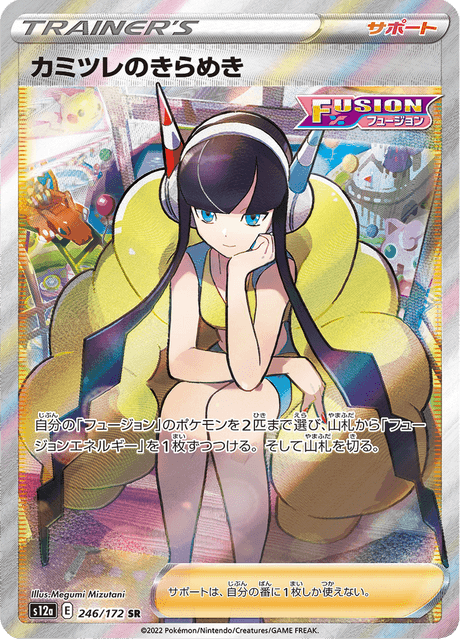
The Giratina VSTAR Special Art Rare (s12a-261) is the undisputed flagship of the set and currently sits at $270.29 in PSA 10 with a 30-day sales volume of 431 graded copies, making it both the most expensive and the most actively traded chase card in the entire s12a checklist. The artwork shows Giratina mid-emergence from the Distortion World with Cyrus's silhouette in the foreground, a composition that ties the card to Pokemon Platinum nostalgia and gives it crossover appeal beyond pure TCG collectors. The PSA 9 trades at $149.99 and raw copies sit at $158.50, meaning the PSA 10 multiplier over raw is just 1.7x, which is unusually compressed and reflects the tight grading standards on the holographic full-art texture used across s12a SAR cards. The Mewtwo VSTAR SAR (s12a-221) holds the second-highest position at $182.50 in PSA 10, with PSA 9 at $94.82 and raw at $79.00. The 2.3x raw-to-PSA-10 multiplier is more typical of the SAR tier and reflects the difficulty of pulling clean centering on the Mewtwo print, which has known left-edge whitening issues that drop a meaningful percentage of submissions to PSA 9. Charizard VSTAR SAR (s12a-212) is the third major pillar at $181.14 PSA 10, $60.80 PSA 9, $69.97 raw. Charizard demand needs no explanation, but the s12a print specifically benefits from being the only Sword & Shield era Charizard VSTAR alt art in the Japanese pool, with no competing reprint or alternate version. The Darkrai VSTAR SAR (s12a-228) at $119.51 rounds out the top legendary-tier SAR group, supported by the same Sinnoh nostalgia that drives Giratina demand. The Kai (Iono predecessor) trainer SAR (s12a-236) at $117.94 represents the trainer-card chase tier, where waifu-card buyers compete with set completionists and push prices well above the playability floor. Below the $100 line, the Mew AR (s12a-183) at $110.32 is the standout at the AR rarity tier, benefiting from Mew's evergreen demand and the cleaner full-art frame that grades well. The Charizard V SAR (s12a-211) at $109.92 is the V-tier counterpart to the VSTAR SAR and tends to move in correlation with its VSTAR partner. Leafeon VSTAR (s12a-210) at $79.99 captures the eeveelution collector segment, and the Lucario VSTAR SAR (s12a-226) at $78.91, Suicune V SAR (s12a-215) at $73.01, Simisage VSTAR SAR (s12a-214) at $70.41, Hisuian Zoroark VSTAR SAR (s12a-234) at $60.00, and Hisuian Samurott VSTAR SAR (s12a-230) at $55.03 form the mid-tier SAR cluster where most opportunistic graders focus their submission budget. The Galarian Moltres AR (s12a-190) at $52.85, Radiant Charizard (s12a-015) at $50.00, Rayquaza VMAX RRR (s12a-108) at $43.25 with 53 sales in the trailing 30 days, Oricorio AR (s12a-176) at $34.01, and Elesa's Sparkle SR (s12a-246) at $20.00 cover the entry-tier graded market where buy-in stays under $100 raw and PSA 10 returns are still meaningful in percentage terms even if absolute dollar gains are modest.
Pull Rates & PSA 10 Grading Yields
| card_type | pull_rate | psa10_yield |
|---|---|---|
| Common | ~1 per 2 packs | 35-45% |
| Uncommon | ~1 per 2 packs | 35-45% |
| Rare | ~1 per pack | 30-40% |
| RR / V / VMAX / VSTAR | ~1 per 6-10 packs | 20-30% |
| Alt Art V / VSTAR SAR | ~1 per 80-120 packs | 15-25% |
| HR / UR | ~1 per 150-200 packs | 15-25% |
Pull rates are per standard booster pack. PSA 10 yields are estimates based on community submission data.
Investment Analysis
VSTAR Universe occupies an unusual position in the Japanese high-class set hierarchy. The print run was massive, which on its face should suppress long-term price appreciation, but two structural factors counter that: the set has been closed to new printing since early 2023, and the SAR ladder is genuinely deep with multiple cards holding sustained PSA 10 prices above $100 more than three years post-release. The Giratina VSTAR alt art at $270 with 431 trailing 30-day PSA 10 sales is the clearest signal of secondary market health. That sales velocity is roughly 14 graded copies per day moving through the market at a price point that has held within a 15% band for the past 18 months, which is the profile of a card that has found its long-term floor rather than one that is still discovering price. The Charizard VSTAR SAR at $181 and Mewtwo VSTAR SAR at $182 sit in similar territory, with the Charizard arguably underpriced relative to its English Crown Zenith equivalent which trades meaningfully higher despite a comparable print run. The investment thesis on s12a breaks into three tiers. Top tier SARs (Giratina, Charizard, Mewtwo, Darkrai, Kai) are accumulation candidates at current prices for buyers with a 3-5 year horizon, working on the assumption that closed-print Japanese sets compound roughly 8-12% annually once they exit the active printing window. Mid tier SARs in the $50-80 band (Lucario, Suicune, Hisuian Zoroark, Hisuian Samurott) are higher-variance plays where a single character anime appearance or competitive format relevance can push prices 50-100% in a quarter, but where the floor is also softer. Sealed s12a booster boxes are the most defensible long position, with current Japanese retail comparables placing boxes at roughly $180-220 versus an MSRP equivalent of $90 at launch. The expected pull value of a single box at current singles prices runs approximately $60-90 depending on hit luck, which means most of the box premium is collector and grader speculation rather than rip-EV, a pattern consistent with mature high-class sets like s8a 25th Anniversary Collection. Compared to English Crown Zenith, s12a has the advantage of being the original printing of the artwork, which historically commands a 20-40% premium over English parallel printings in the Japanese collector market and a meaningful but smaller premium in the international market. The downside risk is concentrated in the mid and lower SAR tier, where the sheer depth of the chase list (over 30 SAR cards across V, VSTAR, and trainer slots) means supply pressure is real even on a closed print.
Collecting Strategies
The budget tier ($50-150) is built around RR and lower-end SAR cards. The Radiant Charizard (s12a-015) at $50 PSA 10, Galarian Moltres AR (s12a-190) at $52.85, Hisuian Samurott VSTAR SAR (s12a-230) at $55.03, Hisuian Zoroark VSTAR SAR (s12a-234) at $60.00, and Simisage VSTAR SAR (s12a-214) at $70.41 give entry-level collectors meaningful exposure to the set's chase aesthetic without committing flagship-tier capital. Raw buy-in for these cards ranges from $11 to $24, which makes graded submission economically rational even at PSA's standard tier pricing. The mid tier ($150-400) targets the secondary chase cards. Suicune V SAR (s12a-215), Lucario VSTAR SAR (s12a-226), Leafeon VSTAR (s12a-210), Charizard V SAR (s12a-211), and Mew AR (s12a-183) all sit in the $73-110 PSA 10 range and become attractive accumulation targets when bought in raw lots and submitted in batches. The Darkrai VSTAR SAR (s12a-228) at $119.51 is the highest-value card in this tier and the cleanest single-card investment for collectors who want SAR exposure without paying flagship prices. The investment tier ($400+) concentrates on the top SAR trio: Giratina VSTAR alt art (s12a-261) at $270.29, Mewtwo VSTAR SAR (s12a-221) at $182.50, and Charizard VSTAR SAR (s12a-212) at $181.14. These three cards collectively represent over 60% of the secondary market dollar volume on the s12a checklist and are the cards most likely to defend their value through the next market cycle. Sealed VSTAR Universe booster boxes are the alternative investment vehicle in this tier, currently trading at $180-220 per box with no realistic prospect of additional reprinting given that the set has been closed for over three years. A complete master set in PSA 10 would require roughly $4,500-6,000 at current prices and is realistic only for collectors who are willing to grade in volume and accept that some lower-tier cards will return PSA 9 grades that need to be resubmitted or accepted as gem mint substitutes.
Frequently Asked Questions
How many cards are needed for a complete VSTAR Universe master set?
A complete s12a master set requires 172 cards in the numbered portion plus all SR, SAR, HR, and UR variants in the unnumbered slots above 172, bringing the working total to roughly 200-220 unique cards depending on how variants are counted. The numbered 1-172 portion is achievable for most collectors at a raw cost of $400-600. The full chase ladder above 172 is where the cost concentrates, with the top SAR trio alone (Giratina, Mewtwo, Charizard) accounting for over $600 in raw prices and over $1,800 in combined PSA 10 value. Most collectors target a partial master set focused on either the SAR ladder or the AR/RR tier rather than attempting full completion.
Why does Giratina VSTAR command such a premium over other SAR cards?
Giratina VSTAR alt art (s12a-261) sits at $270.29 PSA 10 because three demand drivers stack on a single card. First, the Cyrus and Distortion World composition ties directly to Pokemon Platinum nostalgia, which is the strongest single-game nostalgia driver in current TCG collecting. Second, Giratina has no comparable English alt art, since Crown Zenith uses a different Galarian Gallery composition. Third, the PSA 10 sales velocity of 431 copies in the trailing 30 days proves the demand is broad rather than concentrated in a few buyers. The combination of nostalgia, Japan-exclusive artwork, and proven liquidity is rare and supports sustained premium pricing.
Why is there no direct English equivalent of VSTAR Universe?
Pokemon TCG International handles set localization on a different schedule and structure than Pokemon Japan. For the close of the Sword & Shield block, the international team chose to split the s12a card pool across two products rather than ship a single mega-set. Silver Tempest in November 2022 absorbed most of the V and VSTAR cards, and Crown Zenith in January 2023 took the Galarian Gallery and most SAR alt arts. The split was driven by product mix considerations, since Crown Zenith was packaged primarily as a premium ETB-driven release rather than as a standard booster set. Even combined, the two English sets do not reproduce the full s12a checklist, and several Japanese-exclusive cards remain.
What is the expected value of a sealed VSTAR Universe booster box?
A sealed s12a booster box contains 10 packs at 11 cards per pack. Based on current singles prices and published pull-rate ranges, the average expected value of a single box at retail singles prices is approximately $60-90 depending on hit luck, with the variance dominated by whether the box yields any of the top-tier SAR pulls. Given that boxes currently trade at $180-220 in the Japanese market, the box premium of $100-130 over rip-EV reflects collector and sealed-product investment demand rather than pure pull-value math. This is the standard pattern for closed-print Japanese high-class sets and is not specific to s12a.
How does VSTAR Universe compare to Crown Zenith for collectability?
Crown Zenith is the closest English analog to s12a and the two are often discussed together. Crown Zenith generally trades at higher prices than s12a on directly comparable cards in the international market, but s12a has the structural advantage of being the original printing of the shared artwork. In the Japanese collector market, s12a originals consistently command premiums over English Crown Zenith parallels of 20-40%. For collectors building a single VSTAR-era display, s12a is the more complete checklist with cards that simply do not exist in Crown Zenith, while Crown Zenith offers the convenience of English text and easier grading turnaround through North American services.
Which single card is the best long-term investment in s12a?
The Giratina VSTAR alt art (s12a-261) at $270.29 PSA 10 is the strongest single-card investment based on three measurable signals: 30-day sales volume of 431 graded copies confirms deep liquidity, the 1.7x raw-to-PSA-10 multiplier suggests the price is supported by collector demand rather than grading scarcity alone, and the Japan-exclusive composition removes the substitution risk that affects cards with English parallels. Charizard VSTAR SAR (s12a-212) at $181.14 is the secondary pick for collectors who prioritize Charizard exposure over Sinnoh nostalgia. Both cards have held within a 15% price band for the past 18 months, which is the profile of cards trading at long-term floor rather than at speculative peaks.
What PSA 10 yield should I expect on s12a alt art SAR submissions?
Alt art V and VSTAR SAR cards from s12a typically grade at 15-25% PSA 10 yield from raw mint condition. The yield is suppressed by two specific issues common to the s12a print: holographic texture sensitivity that picks up handling marks easily, and centering tolerance on full-art frames that runs tight on the left and right edges. Cards stored in penny sleeves and toploaders from pack-fresh condition will land in the upper end of that range. Cards that have been handled, traded, or stored loose will land at the lower end or fail to PSA 9. Pre-grading inspection under angled lighting is critical to avoid submitting cards with edge whitening or surface scratches that will not return PSA 10.
How does Charizard VSTAR SAR (s12a-212) compare to Charizard ex SAR from sv2a?
Charizard VSTAR SAR (s12a-212) at $181.14 and the Charizard ex SAR from sv2a 151 trade at different price points and serve different collector segments. The s12a Charizard VSTAR is the closing-era Sword & Shield Charizard with full-art SAR treatment and is positioned as a Galarian-era flagship. The sv2a Charizard ex from Pokemon 151 is a Scarlet & Violet-era card that ties directly to the original 151 Kanto roster and benefits from the broader 151 nostalgia wave that has driven sv2a prices well above other modern Japanese sets. The sv2a Charizard generally trades higher due to that 151 demand, but the s12a version is the more defensible long-term hold for collectors who specifically want Sword & Shield era exposure.
Are s12a singles still being reprinted or is the set closed?
VSTAR Universe was closed to new printing in early 2023, approximately three months after launch, when production capacity shifted to the Scarlet & Violet block. There have been no confirmed s12a reprints since that point. The set is therefore in the closed-print category, where total supply is fixed and price action is driven entirely by secondary market dynamics rather than ongoing primary supply. This is the standard pattern for Japanese high-class sets, which historically receive aggressive print runs at launch followed by hard cutoffs once the next block begins. The closed-print status is a meaningful factor in the long-term investment case for s12a SAR cards.
What is the difference between SAR, SR, and AR rarity in s12a?
SAR (Special Art Rare) cards in s12a are full-art alt art treatments of V, VSTAR, and trainer cards, numbered above the main 172-card checklist. SR (Super Rare) is the holographic textured treatment of trainer cards, typically less expensive than SAR for the same character. AR (Art Rare) is a non-holographic full-art treatment introduced in the VSTAR era, used for non-V Pokemon and certain trainers, generally trading below SAR but above standard rare. In the s12a price hierarchy, SAR sits at the top tier ($55-270), AR sits in the middle ($34-110), and SR trainer cards sit in the entry tier ($20-50). The Mew AR (s12a-183) at $110.32 is the highest-priced AR in the set.
Should I buy raw and grade or buy already-graded PSA 10 copies?
The decision depends on the specific card and current raw-to-PSA-10 multiplier. For Giratina VSTAR alt art, the 1.7x multiplier ($158.50 raw to $270.29 PSA 10) leaves limited margin after grading fees and the risk of returning PSA 9, so buying graded PSA 10 is often the more efficient path. For mid-tier SARs like Lucario VSTAR SAR (raw $12.35 to PSA 10 $78.91, a 6.4x multiplier), grading is meaningfully more profitable when yield is acceptable. The break-even calculation should account for PSA grading fees, shipping both directions, and the realistic PSA 10 yield rate of 15-25% on alt art SAR submissions. Cards with raw-to-PSA-10 multipliers below 2.5x generally favor buying graded; multipliers above 4x generally favor raw and grading.
What sleeves and storage are recommended for s12a SAR cards?
VSTAR Universe SAR cards use a textured holographic surface that is sensitive to scratching and edge wear. Standard storage protocol for cards held with grading intent is perfect-fit inner sleeves combined with KMC or Ultra Pro Eclipse outer sleeves, then a semi-rigid card saver or toploader for transport. Magnetic one-touch holders are appropriate for display but not recommended as long-term storage because the magnetic closure can introduce micro-pressure on the card edges over multi-year periods. Humidity control matters for Japanese cards because the cardstock is slightly thinner than English cardstock and is more prone to warping in environments above 60% relative humidity. Silica gel packs in the storage container are a low-cost preventive measure.