Blue Sky Stream PSA 10 Guide
Set History & Release Context
blue sky stream (s7r) launched on july 9, 2021 as one half of a paired sword & shield expansion structure that pokemon japan used twice during the s-block era. the companion set, skyscraping perfect / s7d (sword side), released on the same day. the two japanese sub-sets were designed to be opened together, with shared trainer reprints and a card pool that pokemon tcg international later combined and expanded into the english evolving skies set, which shipped on august 27, 2021. the s7r main checklist runs to 67 numbered cards plus the unnumbered sr/hr/ur tier above 067, with the rayquaza-themed chase ladder concentrated in the 075-085 range. the s7d sister set ran a similar 67-card structure focused on the duraludon vmax and other dragon-type chase pulls. when collectors talk about a 'blue sky stream box' they usually mean a 30-pack japanese box of s7r specifically, which is distinct from the english evolving skies booster box that contains the merged card pool. the dual-set structure has caused persistent confusion in the secondary market. cards numbered s7r-xxx and s7d-xxx are not interchangeable even when they share artwork with the same english evolving skies card, because the japanese print code, set symbol, and back-stamp differ. graders treat them as separate populations and the price spreads between the two sub-sets can run 20-40% on shared artwork depending on which side carries the more desirable chase pull. the set arrived during the peak of the 2020-2021 pokemon collecting boom that followed the original logan paul / charizard era, and pokemon company japan responded with what trackers at the time described as the largest japanese print run since base set, with multiple reprint waves running through late 2021 and into early 2022. that aggressive reprinting kept booster boxes available at near-msrp through most of the first six months, which is the standard pattern for s-block japanese sets but a sharp contrast with english evolving skies, which sold out at retail almost immediately and has traded at multiples of msrp on the sealed market ever since. the english counterpart's scarcity is the single most important external factor on s7r pricing, because international collectors who are priced out of english evolving skies treat s7r and s7d as the substitute supply.
Japanese vs English
blue sky stream (s7r) and skyscraping perfect (s7d) released simultaneously in japan on july 9, 2021 as a deliberately paired dual-set structure. seven weeks later, on august 27, 2021, pokemon tcg international shipped evolving skies as a single combined english set that absorbed the card pool from both japanese sub-sets and added several cards that did not appear in either s7r or s7d. evolving skies became, almost immediately on release, the most expensive english pokemon set since base set in 1999, driven by a confluence of factors that did not affect the japanese originals. english supply was constrained by the global pokemon shortage of late 2021, which followed the early-pandemic collecting boom and the logan paul charizard era. evolving skies booster boxes that retailed at $145 msrp at launch traded above $1,200 by december 2021 and have continued to appreciate through 2024 and into 2026. the umbreon vmax alt art (evolving skies 215) became one of the highest-priced single cards in the modern english tcg secondary market, with psa 10 copies trading well above $1,500 and sealed booster box prices supported by graders who target that single card. the rayquaza vmax alt art (evolving skies 218) sits in the second tier of english evolving skies chase pulls and trades at psa 10 prices that are meaningfully higher than any equivalent rayquaza variant on the japanese s7r checklist except the rainbow rare hr (s7r-083). the structural reason for the japanese discount is supply. pokemon japan ran multiple reprint waves of s7r and s7d through late 2021 and into 2022, while pokemon tcg international did not reprint evolving skies in any meaningful volume after the initial 2021 launch run. the english supply has therefore tightened consistently year-over-year while the japanese supply was set at a much higher initial level and has not been further constrained. the practical consequence is that the s7r/s7d combined japanese cards trade roughly 40-55% below the equivalent english evolving skies card on directly comparable pulls, with the gap widening as you move down the chase ladder from hr/sr to standard rr. the exception is the s7r-083 rainbow rare rayquaza vmax hr, which has no english equivalent and trades at parity with global rainbow-rare market pricing. for collectors deciding between s7r and english evolving skies, the calculus depends on goal. for pure investment in the rayquaza alt art ip, japanese s7r offers more favorable entry pricing on most variants and exposure to the unique rainbow rare on s7r-083. for collectors who specifically want the english evolving skies set in display or completion form, there is no japanese substitute because the english eeveelution alt arts (umbreon, sylveon, leafeon, glaceon) and the rayquaza vmax alt art carry their own english-specific premiums driven by domestic us collector demand. the dual-set s7r/s7d structure also means that collectors building the japanese equivalent of english evolving skies need to source from both halves, which adds sourcing friction but does not change the underlying value math.
Blue Sky Stream PSA 10 Cards
2 cards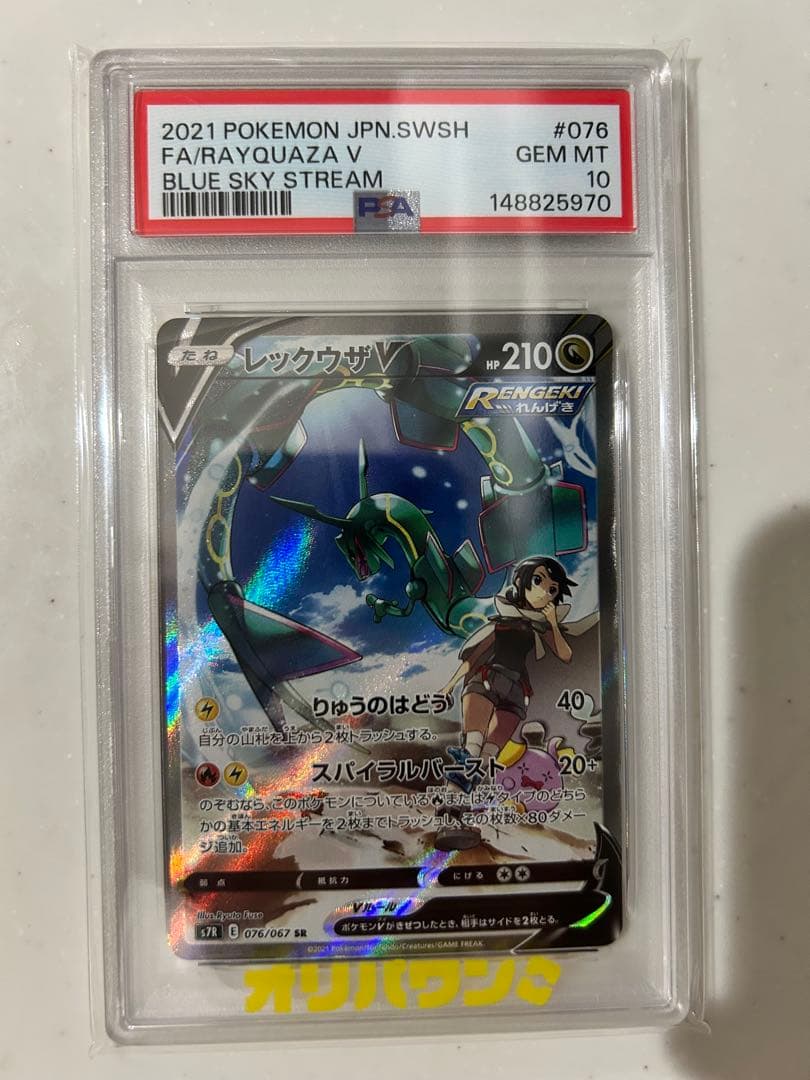
Top Chase Cards Explained
the rayquaza vmax hr (s7r-083) is the undisputed flagship of blue sky stream and currently sits at $3,452.95 in psa 10. this is the rainbow rare hyper rare treatment of the rayquaza vmax, with the full rainbow foil texture across the entire card face and the secret rare slot above the numbered checklist. raw copies trade at $1,258.85 and psa 9 sits at $1,861.76, which gives a raw-to-psa-10 multiplier of roughly 2.7x and a psa-9-to-psa-10 step-up of 1.85x. those multipliers are tight for a card at this price point and reflect the difficulty of grading the rainbow holographic surface, which is sensitive to even microscopic scratches and tends to fail at psa 10 when the centering on the textured frame runs more than 55/45. the rayquaza v sr 'head number 777' (s7r-076) is the second-tier flagship at $1,342.61 in psa 10. the head 777 designation refers to the print serial number visible on the card, which is a known collector flag for a specific run of the rayquaza v secret rare alt art. raw copies trade at $354.72 and psa 9 sits at $409.14. the raw-to-psa-10 multiplier of 3.8x is more typical of the sr alt art tier and reflects collector willingness to pay for the head 777 designation specifically rather than any random rayquaza v sr copy. the rayquaza vmax hr (s7r-082) at $182.08 in psa 10 is the third rayquaza chase, and the variant numbering here is the source of constant confusion. s7r-082 and s7r-083 are both rayquaza vmax hr cards but the 083 version carries the rainbow rare treatment while 082 is the standard hyper rare gold/silver variant. raw copies of 082 trade at $54.00 and psa 9 sits at $103.30, giving a raw-to-psa-10 multiplier of 3.4x. the spread between 082 ($182) and 083 ($3,453) is one of the widest within-set spreads on any japanese pokemon set and is driven entirely by the rainbow rare premium on 083. the rayquaza vmax rrr (s7r-047) at $57.00 in psa 10 is the entry-tier rayquaza chase and the most accessible card for collectors who want rayquaza exposure without committing to the hr or sr tier. raw copies trade at $4.00 and psa 9 sits at $19.25, giving a raw-to-psa-10 multiplier of 14.3x, which is the highest multiplier among the tracked s7r chase cards and the strongest pure grading-arbitrage opportunity in the set. beyond the four tracked cards, the blue sky stream chase ladder includes additional sr and hr variants of duraludon (concentrated in the s7d sister set), the leafeon vmax / glaceon vmax alt arts that crossed into english evolving skies as some of the most expensive english cards of the modern era, and umbreon vmax alt art which became one of the highest-price single cards in the entire english tcg secondary market. several of those eeveelution alt arts sit on the s7r side of the dual-set structure while others sit on s7d, and collectors building a complete set need to source from both halves.
Pull Rates & PSA 10 Grading Yields
| card_type | pull_rate | psa10_yield |
|---|---|---|
| common | ~1 per 2 packs | 35-45% |
| uncommon | ~1 per 2 packs | 35-45% |
| rare | ~1 per pack | 30-40% |
| rr / v / vmax | ~1 per 6-10 packs | 20-30% |
| sr / alt art v | ~1 per 80-120 packs | 15-25% |
| hr / ur / rainbow rare | ~1 per 150-200 packs | 10-20% |
Pull rates are per standard booster pack. PSA 10 yields are estimates based on community submission data.
Investment Analysis
blue sky stream sits in an unusual position in the japanese high-class hierarchy because its english counterpart has become the single most expensive english pokemon set since base set, while the japanese original trades at a fraction of english prices on directly comparable cards. the rayquaza vmax alt art that english evolving skies prints as the headline chase commands four-figure psa 10 prices in english but the s7r japanese version of comparable rayquaza vmax variants can be acquired at meaningfully lower prices for everything except the s7r-083 rainbow rare flagship. that price gap is the central feature of s7r as an investment thesis. the rayquaza vmax hr (s7r-083) at $3,452.95 is the only s7r card that trades at parity or near-parity with its english counterpart, and that is because the rainbow rare treatment is unique to the japanese print and does not have a direct english equivalent in evolving skies. for that specific card, japanese collectors and international rainbow-rare specialists compete for the same supply and the price reflects global demand. for every other rayquaza variant on the s7r checklist, the japanese price is supported but discounted relative to english, and the spread typically runs 40-55% below the equivalent english evolving skies card. the investment case breaks into three layers. the top layer is the rainbow rare flagship (s7r-083) and the head 777 sr (s7r-076), which trade at four-figure and high three-figure psa 10 prices and are the cards most likely to defend value through the next market cycle. these two cards account for the majority of s7r's secondary market dollar volume and are the cards that bridge into the international rainbow-rare and serial-number collecting segments. the middle layer is the standard hr and sr tier (s7r-082 rayquaza vmax hr at $182), where the japanese discount versus english is widest and the upside scenario is convergence with english pricing as the english supply dries up further over time. the bottom layer is the rrr tier (s7r-047 rayquaza vmax rrr at $57), where raw-to-psa-10 multipliers above 10x make pure grading arbitrage rational for collectors with reliable submission pipelines. sealed s7r booster boxes currently trade at $200-280 in the japanese market versus an msrp equivalent of roughly $50 at launch, which is a 4-5x return on sealed product over four years and is meaningfully lower than the english evolving skies sealed return of 8-12x msrp over the same period. the lower sealed return reflects the larger japanese print run rather than weaker demand. the dual-set structure with s7d adds a second-order consideration. collectors building toward the english evolving skies equivalent need to source from both s7r and s7d, which doubles the sourcing complexity but also provides two separate sealed-product investment vehicles for collectors who want exposure to the broader sword & shield era closing inventory. boxes of both s7r and s7d are typically sold as a paired purchase by japanese retailers, and the combined sealed price runs $400-500 for a matched pair.
Collecting Strategies
the entry tier ($20-100) on s7r is built around the rrr and standard rr cards, with the rayquaza vmax rrr (s7r-047) at $57 psa 10 being the headline target. raw copies of s7r-047 trade at $4.00, which makes the raw-to-psa-10 multiplier 14.3x and turns the card into a pure grading arbitrage opportunity for collectors who can submit reliably. at this raw price, even a 20% psa 10 yield rate on five submissions returns one psa 10 copy at $57 against a raw cost basis of $20 plus grading fees, which is one of the cleanest break-even calculations on any tracked japanese card. the mid tier ($100-300) targets the standard hr and sr variants. the rayquaza vmax hr (s7r-082) at $182 is the central card in this band, with raw at $54 and psa 9 at $103. the 3.4x raw-to-psa-10 multiplier still favors raw and grading for collectors with submission infrastructure but is tight enough that buying graded psa 10 copies makes sense for collectors who do not want the variance of grading the textured hr surface. the high tier ($300-1500) is anchored by the rayquaza v sr head 777 (s7r-076) at $1,342.61, which sits at raw $354.72 and psa 9 $409.14. the head 777 designation specifically commands a premium over generic rayquaza v sr copies, and collectors targeting this card need to verify the print serial before purchase. raw copies in the open market may not all carry the head 777 designation and prices vary accordingly. the flagship tier ($1500+) is the rayquaza vmax hr rainbow rare (s7r-083) at $3,452.95, which is the single most expensive card in the tracked s7r checklist and the card that defines blue sky stream as a high-end japanese set. raw copies at $1,258.85 are still a five-figure investment after grading and slabbing costs, and most collectors at this price point buy already-graded psa 10 copies rather than attempting to grade raw. sealed s7r booster boxes at $200-280 are the alternative investment vehicle and offer exposure to the full chase ladder including the rainbow rare flagship, with the rip-ev calculation favoring sealed holding rather than ripping for collectors with multi-year holding horizons. for collectors building toward the english evolving skies equivalent, the recommended sourcing path is to buy both s7r and s7d sealed boxes as a matched pair from japanese retailers, target raw singles for the rayquaza chase ladder out of s7r, and budget separately for the eeveelution alt arts which split between the two japanese sub-sets and require careful checklist verification before purchase.
Frequently Asked Questions
what is the difference between rayquaza vmax hr s7r-082 and s7r-083?
both cards are rayquaza vmax hr (hyper rare) treatments printed in the secret rare slot above the s7r main checklist, but they are not the same card. s7r-082 is the standard hyper rare variant with gold/silver foil treatment and trades at $182.08 in psa 10. s7r-083 is the rainbow rare variant with full rainbow holographic foil across the entire card face and trades at $3,452.95 in psa 10. the rainbow rare treatment commands an 18x premium over the standard hr because rainbow rare cards are the rarest pull tier in the set and have crossover demand from rainbow-rare specialists who collect this treatment across multiple sets. when buying, verify the card number explicitly because listings sometimes describe both as 'rayquaza vmax hr' without distinguishing the rainbow variant.
is blue sky stream the same set as evolving skies?
no. blue sky stream (s7r) is one of two japanese sub-sets that pokemon japan released on july 9, 2021. the companion japanese set is skyscraping perfect (s7d), released on the same day. pokemon tcg international combined the card pools from both s7r and s7d and added several additional cards to create the english evolving skies set, which released on august 27, 2021. the japanese sub-sets and the english combined set share most artwork but use different print codes, set symbols, and back stamps. graders treat them as separate populations and prices differ meaningfully between the japanese originals and the english combined set.
what does 'head number 777' mean on s7r-076?
head 777 refers to a specific print serial number designation on the rayquaza v sr (s7r-076) that collectors track as a sub-variant of the broader rayquaza v sr print. cards carrying the 777 head number trade at a premium over generic rayquaza v sr copies, and the $1,342.61 psa 10 price specifically reflects the head 777 designation rather than any random copy of the card. when sourcing raw, verify the print serial before purchase because not all rayquaza v sr copies in the open market carry the 777 designation, and the price spread between head 777 copies and standard copies can run 30-50%.
why is english evolving skies so much more expensive than japanese s7r?
english evolving skies has become the most expensive english pokemon set since base set due to severe supply constraints. pokemon tcg international did not reprint evolving skies in meaningful volume after the initial 2021 launch run, which coincided with the global pokemon shortage that followed the early-pandemic collecting boom. japanese s7r, by contrast, received multiple reprint waves through late 2021 and into 2022, which set a much higher total supply level. the result is that the same artwork trades at a 40-55% discount on the japanese side versus the english side for most chase cards. the only exception is the s7r-083 rainbow rare rayquaza vmax hr, which has no english equivalent and trades at parity with global rainbow-rare pricing.
how do i tell s7r and s7d apart when buying?
the print code in the bottom-left corner of the card face is the definitive identifier. cards from blue sky stream are stamped 's7r' and cards from skyscraping perfect are stamped 's7d'. the set symbols also differ: s7r uses a blue cloud-stream symbol while s7d uses a darker dragon-themed symbol. card numbers within each sub-set start at 001 and run independently, so an s7r-047 and an s7d-047 are completely different cards. when buying japanese cards from the july 2021 dual-release window, always confirm the print code before purchase because mislabeled listings are common in international marketplaces that conflate the two sub-sets under the english evolving skies banner.
should i buy s7r singles or sealed boxes for long-term holding?
the answer depends on which exposure you want. sealed s7r booster boxes at $200-280 give exposure to the entire chase ladder including the rainbow rare flagship, with rip-ev calculations favoring sealed holding for multi-year horizons. singles give targeted exposure to specific cards and avoid the variance of pack opening, which matters most when the chase is concentrated in one or two cards. for s7r specifically, the rainbow rare s7r-083 at $3,452.95 represents the bulk of the chase value, and the probability of pulling that card from a single sealed box is low enough that single boxes carry meaningful pull-luck variance. collectors who want guaranteed exposure to the flagship should buy the graded single. collectors who want diversified exposure to the broader chase ladder should buy sealed boxes.
what is the psa 10 yield rate on s7r rainbow rare cards?
rainbow rare hr cards from s7r typically grade at 10-20% psa 10 yield from raw mint condition, which is meaningfully lower than the 15-25% yield rate on standard sr alt art cards from the same era. the suppressed yield is driven by two specific issues with rainbow rare prints: the rainbow holographic foil is more sensitive to handling marks than standard hr foil and tends to pick up micro-scratches even in protective sleeves, and centering tolerance on the full-art rainbow frame runs tight enough that anything outside 55/45 typically returns psa 9. cards stored in penny sleeves and toploaders from pack-fresh condition land at the upper end of the yield range. cards that have been handled or stored loose typically fail to psa 10.
are s7r and s7d still being reprinted?
no. both blue sky stream and skyscraping perfect were closed to new printing in early 2022 when production capacity shifted to the s8 fusion arts and s8a 25th anniversary collection releases. there have been no confirmed reprints of either s7r or s7d since that point. the sets are in the closed-print category, where total supply is fixed and price action is driven entirely by secondary market dynamics. this is the standard pattern for japanese sword & shield era sets and is a meaningful factor in the long-term investment case for s7r chase cards.
how does s7r compare to other 2021 japanese sets like s8a 25th anniversary?
s7r and s8a (25th anniversary collection) are both 2021 japanese releases but serve different collector segments. s7r is a standard expansion set with rayquaza as the central chase ip and trades primarily on the strength of the rayquaza vmax variants. s8a 25th anniversary is a celebration set with the famous mew vmax and other anniversary chase cards, and trades at higher overall prices than s7r due to the anniversary positioning. for collectors building 2021 japanese exposure, s7r offers more affordable entry into the chase ladder with the rrr and standard hr variants while s8a offers the higher-prestige anniversary inventory at proportionally higher prices. both sets share the structural advantage of being closed to new printing since 2022.
what is the rayquaza vmax rrr (s7r-047) and is it worth grading?
the rayquaza vmax rrr (s7r-047) is the standard triple rare rayquaza vmax from blue sky stream, distinct from the hr and sr alt art variants. it trades at $57.00 in psa 10 with raw copies at $4.00 and psa 9 at $19.25. the raw-to-psa-10 multiplier of 14.3x is the highest among tracked s7r chase cards and makes this card a pure grading arbitrage play for collectors who can submit reliably. at this raw price, even a 20% psa 10 yield rate on five raw submissions returns one psa 10 copy against a raw cost of $20 plus psa grading fees, which makes the break-even economics favorable. the rrr surface is also less sensitive to handling than the hr or rainbow rare surface, which supports a higher yield rate.
why does s7r have only 67 numbered cards when other japanese sets have 100+?
the 67-card count on s7r reflects the dual-set structure used for the july 2021 release. pokemon japan split what would otherwise have been a single 130-card set into two sub-sets of roughly 67 cards each, with s7r covering one half of the card pool and s7d covering the other half. shared trainer reprints appear on both sides, and the chase pool is divided so that some major alt arts sit on s7r while others sit on s7d. when collectors compare s7r to a single 100+ card japanese set, the relevant comparison is the combined s7r + s7d pool of roughly 130-140 unique cards, which sits in the standard range for a major japanese expansion. the dual-set structure was used twice during the s-block era and was not repeated in the scarlet & violet block, where pokemon japan returned to single-set releases.
can i build the english evolving skies set using only japanese s7r and s7d cards?
not completely. english evolving skies absorbed most but not all of the s7r and s7d card pool, and added several cards that do not appear in either japanese sub-set. the eeveelution alt arts (umbreon vmax, sylveon vmax, leafeon vmax, glaceon vmax) split between s7r and s7d in the japanese print, but the english evolving skies versions of these cards use slightly different artwork treatment and carry english-specific text and back stamps. collectors who want a display set that matches the english evolving skies checklist exactly need to source english cards. collectors who want the equivalent japanese inventory of the same artwork need to source from both s7r and s7d, accept that some english-exclusive cards will not be available in japanese, and verify each card by print code before purchase to avoid mixing s7r and s7d copies that are easily confused in international listings.